This week we have a presentation for Noam chomsky and his theory 'Manufacturing consent. I watched the film 'Manufacturing consent: Noam Chomsky and the media. Firstly, elite group control thought in a democratic society. Because, 20% population is political class, 80% population follow orders not think. In the US, major media control opinions. This is my presentation.
Achbar, M.,Wintonick, P.. (1992). Manufacturing Consent: Noam Chomsky and the Media. Available: http://www.imdb.com/title/tt0104810/?ref_=fn_al_tt_5 . Last accessed 1st December 2015.
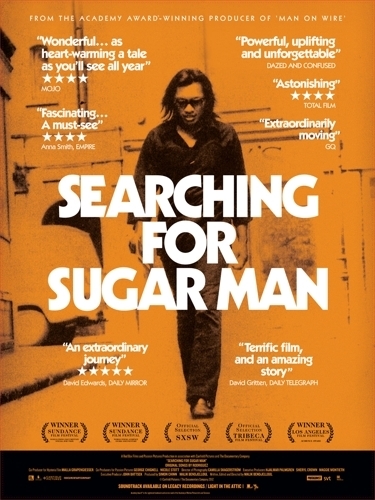
Searching for Sugar Man is a documentary film directed by
Malik Bendjelloul , which details the efforts of two Cape Town fans in the late
1990s, Stephen 'Sugar' Segerman and Craig Bartholomew Strydom, to find out
whether the rumored death of American musician Sixto Rodriguez was true, and,
if not, to discover what had become of him. Rodriguez's music, which never took
off in the United States, had become wildly popular in South Africa, but little
was known about him there. This documentary is elaborately designed with a few
skills of suspense films. Rodriguez himself is extremely dramatic: he’s zero in
US, while hero in South Africa. 36-year-old Swede, Malik Bendjelloul, ever
co-worked with many outstanding musicians, such as Björk and Die Prinzen,
during the work at a TV station, so he is an insider without doubt. He was
completely amazed the first time he heard Rodriguez’s song in Cape Town when he
resigned in 2006 and went for backpacker tourism in Africa with then
girlfriend. Malik originally planned to make a seven-minute video to be
broadcasted on TV, however, only collecting information had taken several
months. Malik told himself over and over again: This is a bigger story, and
this should be a movie. Malik decided to stay in Cape Town and made friend with
Rodriguez through the latter’s daughter. However, it is at the third year when
Malik flew to Detroit that these two men met each other. At first, Rodriguez
was reluctant to be shot, but when he saw Malik shot the snow scene of Detroit
early in the morning at minus 20 degrees, he was deeply touched by that young
face, red with cold and agreed to take a very short interviews. The biggest
difficulty lay in funds. If you are an investor, would you invest in a
documentary about an artist that nobody knows about, the directorial debut of a
young director? Swedish Film Institute ever provided him support funds, which,
however, was withdrew in the third year of film shooting. At first, Malik used
Super 8 video camera, but then, he could not afford the Super 8. At that time,
he was excited to find that there was a Super 8 APP in Apple’s App store, so he
took most of his material by using this APP priced 1 dollar. Until 2011, the
actual shooting part had been basically completed, and the rest parts were
post-editing and sound soundtrack, as well as the most important cut scenes.
Paying everything for Searching for Sugar Man, Malik almost had nothing to keep
it going on. He began to pick up the brush and make some simple illustrations
by himself; on the table at him home in Stockholm, he struggled with editing
software. This is how he completed the film, suffering various difficulties.
His film might be the most inexpensive one, but indeed the best one.
The genre of documentary according to American theorist Bill Nichols, documentary can be divided into the following six genres:
Poetic documentary
Poetic documentary appeared in the 1920s and one of the representative work is called 'Rain' directed by Joris Ivens. The genre of documentary does not emphasize the narrative, the time to create and coherent editing. It is focus on rhythm the creation and the combined of different spatial. It aims to convey the emotion and mood.
Expository documentary
Expository documentary appeared in the 1920s. The genre of documentary's publicity intension is clear and pay attention of the commentary to convince the audience to accept their point of view, the typical characteristic in form of 'the voice of god', the material edit and omniscient viewpoint.
Observational documentary
Observational documentary appeared in the 1960s. The technology is based on emergency of portable camera and tape camera. The genre of documentary has not commentary and specific actors. The filmmaker like a 'fly on the wall'. Observational documentary is mainly expressed the real world. It is difficult to deal with historical themes. Expression of image can easily become boring in the absence of narration of subtitles.
Reflexive documentary
Reflexive documentary appeared in the 1980s and one of the representative work is 'Surname viet of given name nam'. The genre of documentary's characteristic is present the social and historical process itself reflection. It same like other documentaries, importance of the real things. The most important is the reflection of the director to the documentary.
Participatory documentary
Filmmaker does interact with subject and does not cover-up filmmaker appear in the film. This interaction is present within the film. The participatory documentary appeared in 1960s and one of the representative work is 'chronicle of summer 'directed by Jean Rouch and Edgar Morin.
Performativity documentary
Performativity documentary will be subjective to enlarge of a real event and departure from the realism style. It emphasizes the subjective expression of the creators. One of the most representative work is 'tongues united' directed by Marlon Roggs. The genre of documentary usually similar with avant-garde film.
References:
Nichols,B. (1942) Introduction to
documentary, 2nd edn., Indiana,USA: Bloomington : Indiana University Press.
Last week, we have a homework to make a three-act beat structure, the topic is 'getting a locked door open in an emergency'.
Daniel is a high school student, his parents go outside to look after his grandparents. He played x-box in the room. He play games all day, he feel very dizzy. He prepare go to bath room and go back to take a rest. When he open his door of bedroom, he do not why he cannot open. He continuously push the door. He have not eaten all day, so he feel very weak. He starts becoming go crazy. He kick the door like he control the man in the game. Finally, he smash the door open. Simultaneously, his parents back to home and watch these. 'Why you broken your door?' his parents ask.
'I cannot open it, when I push it.' Daniel said. His parents reply, oh my god, don't you remember you need to pull it?'
Interactive film is the video game which is between audience and viewing. Interactive film need audience to control the plot or characters. It is like a video game. Interactive film emphasis the plot of the story, through the full- motion video. Audience can choose the options and follow their point of view to story development.
What is the new experience that is available to the audience?
As a participants, audience take part in the film and to control the film that is a brand new experience. They could be wave their hand or put hands up and so on. In the past, the audience just a viewer or onlooker, audience could not involve to the movie. Sometimes, audience hope the story follow their own opinion to develop, so interactive film can satisfy their needs.
What example of practice can you find of the above?
This is example of practice that needs audience to decide continuous plot.
What can we expect in future?
People can watch interactive film in the home. A same interactive film, different audience can get different story and ending. They can discuss their own ending and how to made it. I think that will be a interesting experience in the future.
Do you think, from your research, it will become important or stay a 'niche' experience?
I hope interactive will develop more popular. In my opinion, some of people hope to have a relax mood in the cinema. They do not want to decide something or wave their hands. Just keep quiet follow the storyline, finish the movie. In addition, many classical movies have splendid storyline, if the storyline is depended by audience, it will not a good story. Thus, I think interactive film will become a minority experience.
People usually think a documentary shooting in uncontrolled situations. However, there are three basic type of documentary productions: using found footage, shooting in a controlled situation and shooting in a uncontrolled situation. Firstly, the filmmaker need to analyze the visual material and define the basic visual in the pictures. The principle of contrast and affinities created by the visual components will influence the visual structure of the final production. Secondly, a controlled documentary situation allow the director to control the visual component. For example, how to set up the background, space, lighting,shots and so on. A documentary like a story, have a core conflict. The conflict could be occur between filmmaker and audience. The conflict become 'will the audience understand the information presented by the filmmaker?' A documentary must have a point of view. If a documentary have not a point of view, the visual components will not exist, even through the emotion of audience. In a uncontrolled circumstance to shoot a documentary that is a tough works. Because the film makers do not know to predict what, if anything. In the circumstance, a filmmaker need to know own point of view. When something happened in uncontrolled situation, how do you want the audience to feel emotionally about it? You need to make a properly visual structure plan to fit the current circumstance. The most control comes in the editing room. The footage can be analyzed to the visual components. The action and story depend on the cut and combine ways.
References:
Block, B,A. (2008) The visual story : creating
the visual structure of film, TV and digital media, 2nd edn., Oxford:
Focal.